Queer Places:
University of Cambridge, 4 Mill Ln, Cambridge CB2 1RZ
Lancing College, College, Lancing BN15 0RW, United Kingdom
University of Nottingham, Nottingham NG7 2RD, United Kingdom
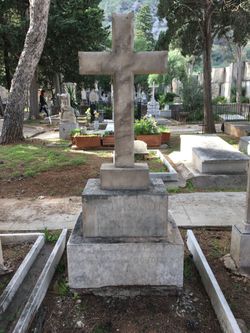
Cimitero di Santa Maria dei Rotoli, V. Papa Sergio I, 96, 90142 Palermo PA
 John Elliotson Symes (1847 – March 31, 1921) was born in 1847, possessing roots connected to Bourdon House on Berkeley Square in London. Embarking on a distinguished
academic path, he entered Downing College, Cambridge, as a scholar on October 11, 1867, matriculating in the Michaelmas term of that year. During his undergraduate studies,
he distinguished himself not only through the Mathematical Tripos—earning his Bachelor of Arts degree in 1871 followed by his Master of Arts in 1874—but also through
high-profile student leadership. In 1870, he served as the President of the Cambridge Union Society. Furthermore, his intellectual standing and social circles at the
university led to his membership in the Cambridge Apostles, the prestigious and secretive intellectual discussion society.
John Elliotson Symes (1847 – March 31, 1921) was born in 1847, possessing roots connected to Bourdon House on Berkeley Square in London. Embarking on a distinguished
academic path, he entered Downing College, Cambridge, as a scholar on October 11, 1867, matriculating in the Michaelmas term of that year. During his undergraduate studies,
he distinguished himself not only through the Mathematical Tripos—earning his Bachelor of Arts degree in 1871 followed by his Master of Arts in 1874—but also through
high-profile student leadership. In 1870, he served as the President of the Cambridge Union Society. Furthermore, his intellectual standing and social circles at the
university led to his membership in the Cambridge Apostles, the prestigious and secretive intellectual discussion society.
Following his graduation, Symes entered the Church and the field of education. He was ordained as a deacon in Chichester in 1873 and subsequently ordained as a priest in
1875. Professionally, he began his career as an assistant master at Lancing College in Sussex, serving from 1872 to 1875. Concurrently, he worked as a University Extension
Lecturer from 1875 to 1881, helping to broaden access to higher education. After a brief tenure as the second master at the Royal Grammar School in Newcastle-on-Tyne between
1880 and 1881, he took up a foundational role in higher education institutions in the Midlands. In 1881, he became one of the four original professors appointed at
University College, Nottingham, serving as Professor of English Literature until 1896. His leadership within the institution culminated in his appointment as Principal of
University College, Nottingham, a role he held with distinction from 1890 until his retirement in 1912. Alongside his academic administration, he contributed to scholarship
through his publications, which included works such as Political Economy and Companion to English History.
Regarding potential LGBTQ links, while explicit contemporary documentation of same-sex partnerships or romantic relationships for Victorian and Edwardian figures is
frequently absent due to the criminalization and social taboos of the era, Symes's inclusion within the Cambridge Apostles provides a notable biographical context. The
Cambridge Apostles—a select intellectual society counting figures like John Maynard Keynes,
Lytton Strachey, and E.M. Forster among its historical orbit—frequently fostered
environments that tolerated and fostered homosocial and homosexual intimacy, aestheticism, and non-conformist personal lives among its members, though direct evidence
regarding Symes's personal romantic inclinations remains part of the broader, often unrecorded private histories of late 19th-century academic elites.
In his later years, Symes returned to London before traveling abroad. He passed away at the age of 73 on March 31, 1921, in Palermo, Italy, as noted in The Times on April
2, 1921. He was laid to rest at the Cimitero di Santa Maria dei Rotoli in Palermo, Città Metropolitana di Palermo, Sicilia, Italy. His headstone bears a simple yet resonant
inscription chosen to mark his legacy: "John Elliotson Symes, Died March 31, 1921, Sent to bear witness of the light."
References:
Other references:
- A Register of S. Nicholas College, Lancing: From its Foundation at Shoreham in August, 1848, to the Commencement of the Month of November, 1900 (Lancing College Register)
- Crockford's Clerical Directory
- The Times (Obituary notice published April 2, 1921)
- Alumni Cantabrigienses: A Biographical List of All Known Students, Graduates and Holders of Office at the University of Cambridge, from the Earliest Times to 1900 (Downing College admissions and matriculation records)
- Cimitero di Santa Maria dei Rotoli, Palermo, Italy (Epigraphic and burial records)
Support this project
This website is a passion project researched, developed, and funded entirely by me. If you find the content valuable and would like to help support the ongoing research and hosting costs, any contribution is deeply appreciated.
Thank you for keeping this independent resource alive!
My books on Amazon: Elisa Rolle's books
BACK TO HOME PAGE
